
Showing posts with label lattice. Show all posts

Thursday, August 25, 2011

Lattice-top Peach Pie

12 comments:
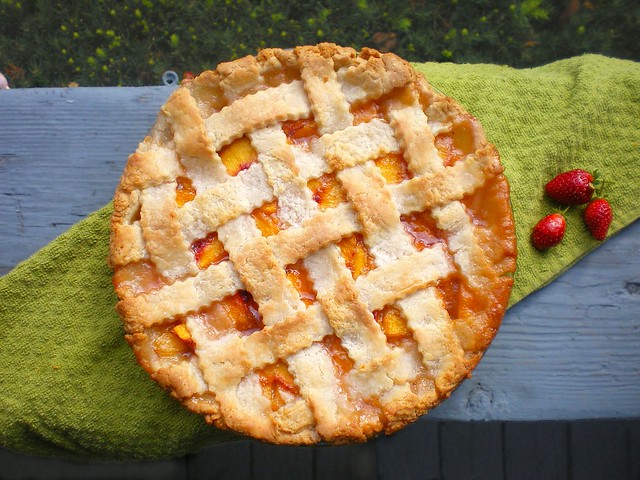
Lattice-top Peach Pie whole

The nights are already starting to get chilly in Boston, and I'm going to miss having in-season watermelon, cherries, and peaches.  While I look forward to the warming food and holidays of autumn, I'm always sad to leave the barbeques, beach trips, and fresh fruits of summer behind.  Peach pie is a constant rival with apple for favorite pie in my book, and I wanted to try a new recipe this summer.  This is a Lattice-top Peach Pie with a cream cheese crust.

Lattice-top Peach Pie

The top crust in the recipe isn't a lattice, but when I flipped to the photos in the middle of the book I saw the same recipe with a lattice and thought, why not?  I'll describe the few adjustments to make when using a lattice in the recipe section after the jump.

Strawberry plant

The other thing I'll miss?  Picking strawberries off my porch.  The sweetness and subtlety of flavors just can't compare with grocery store strawberries.

Strawberry plant 2

Unfortunately, I only pick about 5 a week and they're barely bigger than grapes.  Where are my pints?  If you have strawberry-growing tips, please share!  The information tab on this plant even promised huge berries.

Cutting Lattice Strips

Truth be told, although the cream cheese crust came out perfect, I'd prefer a flaky all-butter crust to pair with peaches.  But I can attest to this same cream cheese crust being perfect for Apple Pie and Banana Cream Pie.  And I'd give the filling a hit of cinnamon next time, as I usually do.  But I can't complain, because it's still a pretty damn good pie.

Lattice-top Peach Pie Unbaked

If you've never done a lattice top, it's honestly one of the easiest parts.  Not lyin'.  Rolling out the dough and trying to prevent rips and tears can rile me up, but weaving those strips in and out takes only a minute.

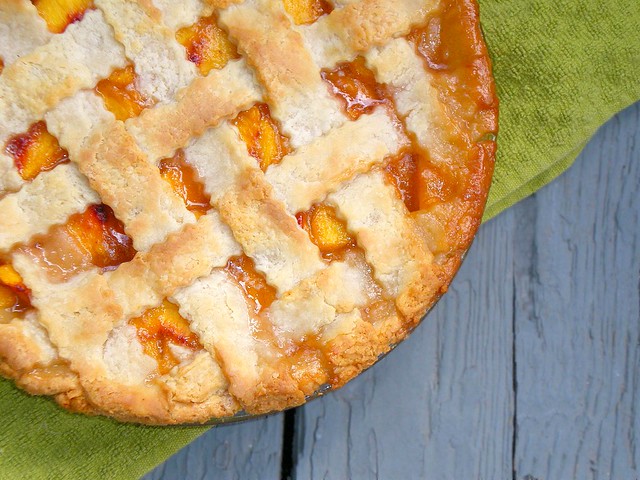
Lattice-top Peach Pie Slice

One last tip: For peeling those soft peach skins, this serrated peeler is amazing.  I found mine at Sur la Table.  I've heard of cutting an X into the bottom of a peach, blanching it in a pot of water, and then plunging it into ice water.  Skip the production and just get a serrated peeler.  Happy baking!

This post is linked to:
* Sweet Treats Party
* Sweets for a Saturday
* Sweet Tooth Friday
* Tea Party Tuesday

Thursday, July 30, 2009

Peach-Vanilla Bean Cobbler with Sugar Crunch Lattice

No comments:
I always wait until summer to make peach cobbler or peach pie. Frozen and canned peaches can't compare, and they aren't as juicy or fragrant. I love peach pie, but cobbler is infinitely easier. There's no bottom crust to worry about getting soggy, and some recipes allow you to just spoon and smooth a batter on top. This one pretties it up with a lattice, yet still looks rustic and easy.

This is great fresh out of the oven, and a scoop of frozen yogurt melts over the top and gives that refreshing chill you want in the sweltering heat (especially after your oven's heated the kitchen). But it's just as delicious at room temperature and free of any accompaniments.
Peach-Vanilla Bean Cobbler with Sugar Crunch Lattice
From The Art and Soul of Baking by Sur La Table and Cindy Mushet
Serves 6 to 8
1 recipe Cream Scones (page 152), prepared through Step 2
2¼ pounds ripe peaches, peeled
¼ to ½ cup (1 ¾ to 3 ½ oz) sugar, plus 2 tbs for the lattice
1 vanilla bean, or 2 tsp pure vanilla extract
2 tsp freshly squeezed lemon juice
2 tsp cornstarch or tapioca flour, or 4 tsp unbleached all-purpose flour
Vanilla ice cream or Vanilla Crème Fraiche, for serving
9-inch ceramic pie pan or other wide 6-cup baking dish

1. Make the filling. Use a paring knife to half and pit the peaches, then cut into ½-inch-thick slices. Transfer to a large bowl. Taste a peach slice — if it is sweet and ripe, use only ¼ cup sugar (or even less, if it is very sweet). If it’s tart or slightly under-ripe, use up to an additional ¼ cup. Place the sugar in the small bowl. Use the tip of the paring knife to split the vanilla bean in half lengthwise. Turn the knife over and use the dull side to scrape out all the seeds into the sugar. Rub the mixture together with your fingers until the seeds are evenly dispersed. Pour over the fruit. Add the lemon juice and cornstarch (and the vanilla extract or paste, if using) and gently toss with the spatula until all the fruit is evenly coated. Press the fruit into the baking dish in an even layer.


Vanilla sugar and vanilla bean-speckled peaches

2. Make the Lattice. Dust your work surface and the top of the dough with flour. Roll the dough into a 16-inch circle about 1/8 inch thick. Rotate the dough slightly each time you roll—this will help you roll the dough in an even circle and will alert you immediately when the dough is sticking to the surface. If it does stick, gently use a bench scraper to release the dough, lifting it off the surface and adding a bit more flour to the surface to prevent further sticking.
3. Cut the dough into 1½-inch wide strips. The strips toward the center of the circle will be longer than the strips toward the edges and this is fine. You will use the longer strips in the center of your baking dish when weaving the lattice, and the shorter strips near the edges of the dish.
4. Weave the lattice. Brush any excess flour from the surface of the dough. Gently lift the strips and place half of them about ½ inch apart from the top of the fruit, letting any excess dough fall over the edge of the dish for the moment. Fold every other strip back halfway, exposing the fruit underneath. Precisely at that halfway point, place a strip of dough perpendicular, laying it over the unfolded strips. Unfold the folded strips, laying them over the new strip of dough. Fold back the strips that were left flat the first time, and place another new strip of dough over the fruit and flat strips of dough. Straighten and tighten the dough each time you do this so your lattice looks even. Continue in this manner until you reach the edge of the pan, then turn the pan and weave the other half of the lattice, beginning at the center and working outward. Once the lattice is finished, use the paring knife to trim any overhanging dough flush with the pan. Chill for 20 minutes.


5. Bake and serve the cobbler. Preheat the oven to 350 degrees and position an oven rack in the center. Sprinkle the lattice evenly with the remaining 2 tablespoons of sugar. You may want to place a baking sheet or a piece of foil under the cobbler to catch any juices that may bubble over. Bake for 40 to 50 minutes, until the topping is nicely browned and the fruit is bubbling and soft (the tip of the paring knife should easily slide in and out of the peach slices). Serve warm or at room temperature, accompanied by ice cream or crème fraiche.

Storing. This cobbler is at its best immediately after baking. Store any leftovers in the refrigerator, covered with plastic wrap, for 2 to 3 days. Reheat, covered loosely with foil, in a 350 degree oven for 40 to 50 minutes, or until warmed through.

Cream Scones
From The Art and Soul of Baking by Sur La Table and Cindy Mushet
2 cups (10 ounces) all purpose flour
¼ cup (1¾ oz) sugar
2½ tsp baking powder
¼ tsp salt
1 stick (4 oz) cold unsalted butter, cut into ½-inch cubes
1 cup (8 oz) chilled heavy whipping cream
1 egg, lightly beaten
1 tbs sugar
1. Preheat the oven to 425 degrees and position an oven rack in the center. Line the baking sheet with parchment paper or a thin silicone mat. Place the flour, sugar, baking powder, and salt in the bowl of the food processor and process for 10 seconds to blend well. Add the cold butter pieces and pulse 5 times at 1-second intervals, or until the butter is cut into medium pieces. Add the cream and pulse another 20 times, or until the dough holds together in small, thick clumps. Use a spatula to scrape the dough out onto a lightly floured work surface. Gently squeeze the clumps together until they form a cohesive dough.
2. Pat the dough into a circle 7 inches in diameter and about 1 inch thick. Use a chef’s knife to cut the dough into 8 equal wedges and transfer to the prepared baking sheet, spacing them about 2 inches apart.

Cobbler prepared with a crust of flower-shaped dough cutouts

Sunday, July 20, 2008

Lattice-top Cherry Pie

2 comments:

It's not hard to do. Really! I'll even show you how to weave the lattice.


After you roll out your bottom crust and tuck it into your pie plate, roll out your top crust (the instructions say to roll it to a 12x10-inch rectangle, but I could never roll out a perfect rectangle; could you?) and cut it into eight strips with your pastry wheel or a knife. I didn't bother measuring, hence the uneven strips. Use the long strips for the center of your pie, and the shorter strips for the sides. Lay five of them vertically across your pie plate.

Then fold down strips 2 and 4, and lay another strip horizontally across the middle. Fold strips 2 and 4 back up. Then fold down strips 1, 3, and 5, and lay another strip horizontally across the top of the pie.


Next, fold up strips 1, 3, and 5, and lay the last strip horizontally across the bottom of the pie. Fold the strips back down, and trim off any overhang with a small knife. You're done!


Final tips: Wear an apron or old shirt when you're pitting those cherries, unless you don't mind red stains on your shirt. I also used regular cherries I found at the supermarket, instead of hunting for sour cherries as the recipe calls for. Still tastes good!


From Ken Haedrich's Pie: 300 Tried-and-True Recipes for Delicious Homemade Pie
Lattice-Top Deep-Dish Sour Cherry Pie
All-Butter Pie Pastry, Double Crust (recipe follows)

For the filling
6 cups fresh sour cherries, stemmed and pitted
1 1/4 cups plus 3 tbs sugar
1/4 cup cornstarch
2 tsp fresh lemon juice
Grated zest of 1 lemon
2 tbs cold, unsalted butter, cut into small pieces

For the glaze
Milk or light cream
Sugar

  • Prepare the pastry as directed, making half of it just slightly larger than the other. Shape the larger half into a disk and the other half into a square. Wrap the pastry as usual and refrigerate until firm enough to roll, about 1 hour.
  • Roll the disk of pastry into a 13 1/2-inch circle with a floured rolling pin. Gently tuck the pastry into a 9 1/2-inch deep-dish pie pan without stretching it, and sculpt the overhang into an upstanding ridge. Place in the refrigerator for 15 minutes.
  • Place the cherries in a large bowl. Mix the sugar and cornstarch together in a small bowl, then stir the mixture into the fruit. Stir in the lemon juice and zest. Set aside for 10 minutes to juice. Preheat the oven to 400 degrees.
  • Roll the remaining pastry into a 12x10-inch rectangle. With a pastry wheel or pizza cutter, cut the pastry into 8 lengthwise strips, each 1 1/4 inches wide. You should have 8 strips measuring 12 inches long and 1 1/4 inches wide. Set aside.
  • Turn the filling into the chilled pie shell, moistening the rim of the shell slightly. Smooth the top of the filling with a spoon or spatula. Dot the filling with the butter. Then follow the instructions at the top of my post for weaving the lattice. Trim the strips, then pinch the end of the strips into the edge of the pastry. Lightly brush the pastry strips with milk and sprinkle the top of the pie with sugar.
  • Place the pie on the center oven rack and bake for 30 minutes. Reduce the oven temperature to 375 degrees and rotate the pie 180 degrees, so that the part that faced the back of the oven now faces forward. Just in case, slide a large aluminum foil-lined baking sheet onto the rack below to catch any spills. (Really do this! The boiling-over is almost inevitable. In fact, do it when you first put the pie in.) Continue to bake until the top is golden brown and any visible juices bubble thickly, 35 to 40 minutes. Transfer the pie to a wire rack and let cool for at least 2 hours before serving.

All-Butter Pie Pastry (double crust)
2 3/4 cups all-purpose flour
1 tbs sugar
1 tsp salt
1 cup (2 sticks) cold, unsalted butter, cut into small pieces
About 1/2 cup cold water

  • Put the flour, sugar, and salt in a food processor. Pulse several times to mix. Scatter the butter over the dry ingredients and pulse 7 or 8 times to cut the butter in well. Remove the lid and fluff the mixture with a fork, lifting it up from the bottom of the bowl. Drizzle half of the water over the dry ingredients. Pulse 5 or 6 times, until the mixture is crumbly. Fluff the pastry and sprinkle on the remaining water. Pulse 5 or 6 times more, until the pastry starts to form clumps. It will look like coarse crumbs. Empty into a large bowl. (If you don't have a food processor, roughly follow the same instructions using your pastry cutter.)
  • Test the dough by squeezing some of it between your fingers; if it seems a little dry and not quite packable, drizzle a teaspoon or so of cold water over the dough and work it in with your fingertips. Using your hands, pack the dough into 2 balls, as you would pack a snowball. Knead each ball once or twice, then shape into a circle and a square and refrigerate for at least an hour or overnight before rolling.


I used the leftover dough and set aside some of the cherry filling to make this personal-sized cherry tart.