Showing posts with label lap cheong. Show all posts

Friday, July 27, 2012

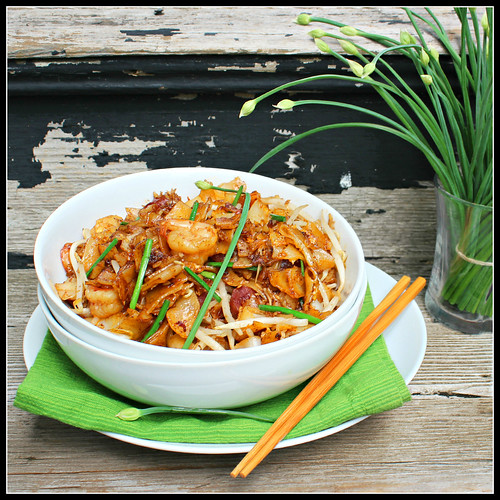
Char Kway Teow (Malaysian Rice Noodles)

8 comments:
Char Kway Teow

This has been on my to-make list for a long time, and I'm happy to have tackled it.  Plus, I wanted to highlight a savory dish since I've covered nothing but sweets lately.  Char Kway Teow, a Malaysian dish of slightly spicy stir-fried rice noodles, is a favorite of mine.  My mother, who is from Malaysia, would often order the dish for me in restaurants when I was a kid.  This version has shrimp, Chinese sausage, Chinese chives, and bean sprouts.  In restaurants in New York or Boston, there is no sausage but there are usually dozens of tiny squids that I ask them to leave out.  Other versions on the Internet call for cockles (no, thanks) or fish cakes (I like those).  But I like everything in this version, and the minimum level of fussiness appealed to me.

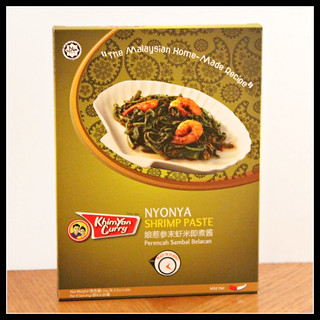
Dried Shrimp Paste

The dried shrimp paste, also known as Belacan, gives it great depth of flavor.  I was unfamiliar with it, and it was not in the Asian market aisle labeled "shrimp paste" but in the Malaysian aisle.  The one fussy-looking step I skipped was roasting it in foil -- I just sauteed until fragrant, and proceeded with the recipe.  And if you've never cooked with the fresh rice noodles before, don't refrigerate them, and use them the day you buy them or they will dry out and harden.  I also doubled the amount of bean sprouts, because what else am I going to do with the rest of the bag?

In the end, making the dish was easier than I anticipated, making me wonder why I waited all these years to try.  And it's pretty darned good.

Thursday, March 22, 2012

Shrimp, Scallion and Lap Cheong Omelets

9 comments:

omelet

This was inspired by a childhood favorite of mine.  Mom often made these omelets with shrimp, but no scallions or vegetables because my picky childhood palate wouldn't tolerate anything green.  When I was older I added the scallions.  Still not a lot in there, but I'm not a fan of diner-style omelets with a pound of cheese and filling.  The freshness of the scallions was great with the crisp and briny bite of fresh shrimp.  You can add soy sauce or oyster sauce like my brother does, or hot sauce like my dad.  And Mom always served these with rice.

Lap Cheong

To add another twist to the omelet, I used lap cheong (widely known by that Cantonese pronunciation, and called la chang in Mandarin).  You'll find these Chinese sausages in the refrigerated section of your Asian grocer, though Mom buys me some fresh from the butcher when I visit her.  If anybody can recommend a good prepackaged brand, since lap cheong vary in flavor and sweetness, I'd appreciate a suggestion in the comments!

Monday, September 12, 2011

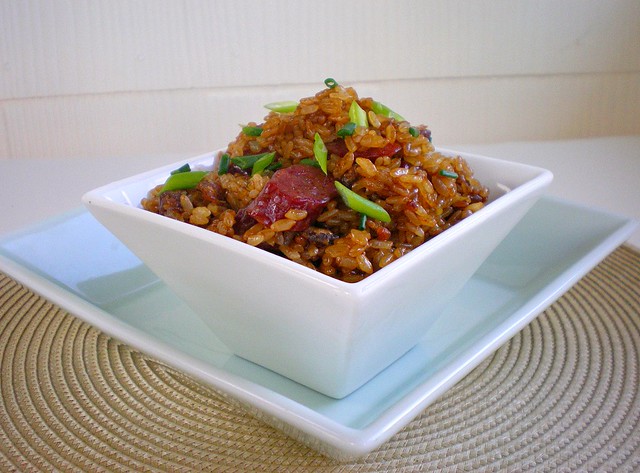
Nuo Mi Fan, or Chinese Sticky Rice

7 comments:
Nuo Mi Fan


Nuo Mi Fan, or Chinese Sticky Rice, is a Chinese household staple.  This is another recipe from Mom, who calls it Luo Mi Fan, but the pronunciation must differ by region because I can't find an "official" one in my searches.  I like mine extra sticky.  I recently discovered that lots of Chinese-Americans will use Nuo Mi Fan in place of a bread stuffing in their turkeys for Thanksgiving.  Mom always used Stovetop, and I've made my own bread stuffing from scratch for years.

Family Collage
Grandpa in the 1940s; Grandma, Dad, and my aunt

However, she said Grandpa, whom I called Ah-gong, used it to stuff his turkeys as well.  Grandpa was a native of Hainan, China, who immigrated to Singapore.  There he worked as a cook on ships, though we inherited no recipes from him.  He was on a ship during a Japanese invasion of Singapore (in the 1940s, I believe), and borders were closed and he ended up in New York City, parted from his family.  Only decades later did he locate my grandmother and Dad, and they rejoined him in New York.  But apparently during that time Grandpa engaged in practices like stuffing turkeys with sticky rice and developing a taste for Irish corned beef, which the Hainanese of Brooklyn called "salty beef."

Nuo Mi Fan Ingredients

One important thing of note is that Nuo Mi Fan usually includes dried mushrooms that are rehydrated.  But I hate mushrooms in any form.  So when Mom taught me this recipe earlier this summer, she omitted them.  That led Dad to ask, "Where are the mushrooms?"  For me the main attraction instead is the Chinese sausage, called la chang or lap cheong.  It's got a different flavor and texture from Western-style sausages, so don't substitute.  Some brands are better than others (I had an awful one once), but Mom got these straight from the butcher for me.  You can freeze them.

Regular long-grain rice won't work in this recipe.  You have to get glutinous rice, also known as sweet rice.  The grains are shorter and rounder and the result stickier, kind of like risotto.

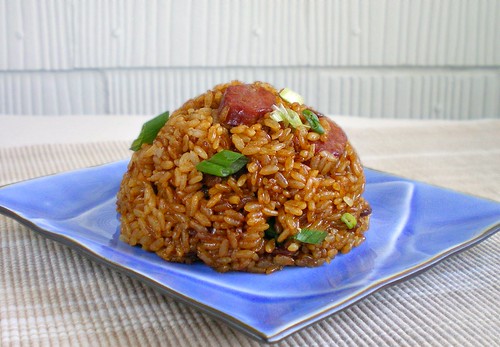
Nuo Mi Fan
Nuo Mi Fan is traditionally plated as a dome

Dried shrimp are common in Chinese cooking, but the unfamiliarity can put some people off.  Give it a try, but if it's a deal breaker or you can't find any, omit them.

Mooncake

And on a side note, it's mooncake time!  The Mid-Autumn Festival starts on Sept. 12 this year, so I bought my mooncakes, or yuebing.  I've noticed some beautiful snowskin mooncakes in various colors on the blogosphere lately.  View a bunch here.