Have you ever tried fen si, or Chinese glass noodles? They're not to be mistaken for the more common rice vermicelli, or mei fun. I'm guest-posting today at Ang Sarap, and chose this childhood favorite when Raymund invited me over. Can I say how thrilled I was at his invitation? I'm constantly impressed by the range of cuisines Raymund makes and posts, not to mention the volume of them. Too often I see Asian recipes lumped in one category, their distinctive characteristics muddled together. But Raymund brings us his native Filipino dishes, along with Vietnamese and Japanese recipes, and cuisines beyond Asia. Ever wondered about Kiwi cuisine? Raymund's got a recipe.
To find out the difference between fen si and mei fun, and to get the recipe for Chinese Glass Noodles with Shrimp, visit Ang Sarap. You'll probably wind up staying there for a while, checking out all Raymund's cooking.
Showing posts with label chinese. Show all posts
Friday, June 21, 2013
Sunday, February 10, 2013
Boston Globe Review: Kam Man
Happy New Year! Or, as my family says, Xin Nian Kuai Le! I hope all of you are safe and warm after Blizzard Nemo. I fell behind with posting, which wasn't important when coping with the storm. On Friday a statewide driving ban was issued in Massachusetts, but exceptions were made for some people including the media so off I went. Driving home from the Globe in the blizzard was surreal and a bit terrifying, and it made me a staunch supporter of the ban. Then the power got knocked out just before I arrived home, along with the heat. It was a punishingly cold night, but electricity and heat returned the next day. Joe did lose a couple fish because the tank got so cold, but otherwise we were fine. My thoughts are with friends and others still without heat or electricity.
I hope there will still be reason for celebrating, with the Year of the Snake beginning today. For this story I reviewed the biggest Asian market south of Boston, Kam Man in Quincy. It's got just about everything you need for your new year in one location, including a bakery and huge housewares section. And beyond Chinese products, it also covers Japanese, Korean, Malaysian, Indian, and Thai cuisines. I also write briefly about Chinese New Year customs.
Read on to find out what I thought: http://b.globe.com/12CWMW2
If the subscriber wall locks you out, proceed to the freebie site: http://bo.st/152woog
I'll leave you with some wintry scenes I snapped with my phone.
Friday, May 18, 2012
Hainan Chicken Rice
We ate lots of Hainan Ji Fan when I was growing up. This poached chicken dish originates from Hainan, an island in China just south of the mainland where my grandparents are from. It's also a popular dish in Singapore and Malaysia, where my parents were born. And my mom continues to make it in her New York kitchen, where she taught it to me on a Mother's Day weekend visit. The best part is the rice. After the chicken is poached, the water essentially becomes chicken stock, and that liquid is used to infuse the rice, making it flavorful and rich. If you have homemade chicken stock on hand, substitute it for some of the water for more potent chicken flavor. The rice is also imbued with garlic and a hint of ginger.
![]() |
| This is how Mom rolls. I don't have a problem with the head, but I have no use for it either. So I bought the usual supermarket variety. |
![]() |
| My parents, brother, paternal grandparents, and my twin sister and me. Once again, not sure which runt I am. |
What are some of your quintessential family recipes?
Thursday, March 22, 2012
Shrimp, Scallion and Lap Cheong Omelets
This was inspired by a childhood favorite of mine. Mom often made these omelets with shrimp, but no scallions or vegetables because my picky childhood palate wouldn't tolerate anything green. When I was older I added the scallions. Still not a lot in there, but I'm not a fan of diner-style omelets with a pound of cheese and filling. The freshness of the scallions was great with the crisp and briny bite of fresh shrimp. You can add soy sauce or oyster sauce like my brother does, or hot sauce like my dad. And Mom always served these with rice.
To add another twist to the omelet, I used lap cheong (widely known by that Cantonese pronunciation, and called la chang in Mandarin). You'll find these Chinese sausages in the refrigerated section of your Asian grocer, though Mom buys me some fresh from the butcher when I visit her. If anybody can recommend a good prepackaged brand, since lap cheong vary in flavor and sweetness, I'd appreciate a suggestion in the comments!
Thursday, January 26, 2012
Nian Gao!
A couple of years ago, I asked Mom for the recipe. Like so many of Mom's recipes, there was no written form or measurements or timing. Which means that if she hasn't made the recipe in a long time, it might not come out right because she doesn't quite remember how it was made. So after telling me "a little of this, and a little of that" over the phone, I tried making her nian gao and ended up with some awful tough thing. This year I turned to Epicurious.
Monday, September 12, 2011
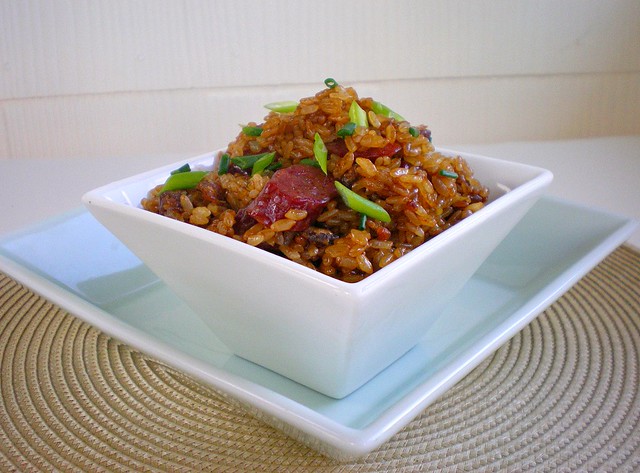
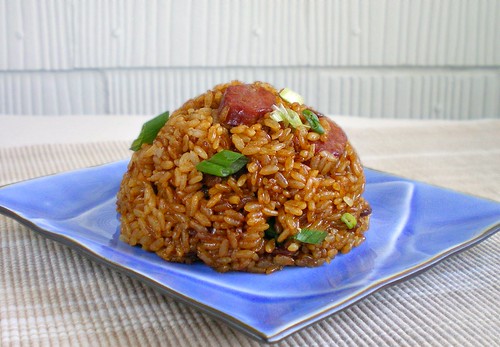
Nuo Mi Fan, or Chinese Sticky Rice
Nuo Mi Fan, or Chinese Sticky Rice, is a Chinese household staple. This is another recipe from Mom, who calls it Luo Mi Fan, but the pronunciation must differ by region because I can't find an "official" one in my searches. I like mine extra sticky. I recently discovered that lots of Chinese-Americans will use Nuo Mi Fan in place of a bread stuffing in their turkeys for Thanksgiving. Mom always used Stovetop, and I've made my own bread stuffing from scratch for years.
Grandpa in the 1940s; Grandma, Dad, and my aunt
However, she said Grandpa, whom I called Ah-gong, used it to stuff his turkeys as well. Grandpa was a native of Hainan, China, who immigrated to Singapore. There he worked as a cook on ships, though we inherited no recipes from him. He was on a ship during a Japanese invasion of Singapore (in the 1940s, I believe), and borders were closed and he ended up in New York City, parted from his family. Only decades later did he locate my grandmother and Dad, and they rejoined him in New York. But apparently during that time Grandpa engaged in practices like stuffing turkeys with sticky rice and developing a taste for Irish corned beef, which the Hainanese of Brooklyn called "salty beef."
Regular long-grain rice won't work in this recipe. You have to get glutinous rice, also known as sweet rice. The grains are shorter and rounder and the result stickier, kind of like risotto.
Nuo Mi Fan is traditionally plated as a dome
And on a side note, it's mooncake time! The Mid-Autumn Festival starts on Sept. 12 this year, so I bought my mooncakes, or yuebing. I've noticed some beautiful snowskin mooncakes in various colors on the blogosphere lately. View a bunch here.
Tuesday, August 30, 2011
Chicken Stir-Fry with Snow Peas
"How did you make that chicken??" Joe insisted on knowing. He couldn't stop talking about how tender and juicy and perfectly cooked it was. I had just thrown some ingredients in the fridge together as a stir-fry, and he loved it. "Is it dark-meat chicken? Thighs?" No. "Then what did you do to it?"
I had fun drawing out the suspense. I had just taken chicken breasts, cut them up, and marinated them for a few minutes in soy sauce, cornstarch, rice wine vinegar, and a bit of baking soda. A later conversation with my mother revealed that restaurants use the baking soda to tenderize beef, not chicken; egg white is used for chicken. Whatever, Mom, it works. No, you won't taste the baking soda, and I wouldn't be worried about consuming it -- it's in baked goods all the time. Worth noting: I like this brand of oyster sauce because it has no MSG.
Kind of worth noting: I have childhood memories of my mom seating me in front of piles of snow peas and having me peel off that tendril at the top and down the side. It annoyed me as a kid, especially since I hated vegetables until college, but I smile to think of it now.
My other guess as to why the chicken turned out so well is that I always try not to overcook meat. I think people get so afraid of undercooking meat that they dry it out and toughen it, and I cooked the chicken just until it was done.
Throw in some garlic and slightly crunchy snow peas, and you've got a delicious and healthy dinner. And a Joe who won't stop eating the chicken when you try to photograph a blog post.
Thursday, November 18, 2010
Mom's Shrimp-Stuffed Eggplant
![]() |
| New photo updated Oct. 2012. |
You might think shrimp and eggplant are an odd combination, unless you've had this dish at dim sum. I love it. Mom still finds it weird to have me snapping shots around her and trying to note every little detail, but I got the recipe! In exchange, I showed her how to make sweet potato biscuits, which I'll be posting soon.
The eggplant is sliced on the diagonal, and then sliced again (but not all the way through) to create a pocket to hold the shrimp. The slices are then filled with shrimp, and browned in the pan. Because eggplant sucks up oil like a sponge, eggplant dishes can be greasy. Mom uses the Chinese method of quickly frying for color and flavor, then steaming the rest of the way through to avoid more oil absorption. The dish is finished off with the usual oyster sauce, and Mom's addition of mirin adds complexity. Use Japanese eggplants, which are slender and long, rather than the short and bulbous Italian variety.
Saturday, September 4, 2010
Singapore Mei Fun
I was happy to tackle this dish since my dad is from Singapore, (though my parental sources informed me it was created by Cantonese people who thought the flavors were like Singapore's, not Singaporeans). Also, because I attempted it a couple of months ago with the result of mushy and crumbled noodles. Happily, all went right with this attempt, and I have another old favorite under my belt. In a departure from the recipe, I used roast pork (char siu) instead of ordinary pork for added flavor. There are roast pork recipes online, but most people, myself included, just buy it from the restaurant.
I learned that all rice vermicelli (mei fun or mi fen) is not created equal, and that certain types hold up better to stir-frying. Also, don't stir-fry the noodles so long that they fall apart on you. My mother recommended this brand from Thailand since she's used it before, but I can't say more beyond that on what brands to look out for. Let me know if you have more guidance in this vein.
Thursday, September 2, 2010
Beef Chow Fun (Beef with Rice Noodles)
So I spent a hectic few days in New York, and learned this recipe from Mom. I wanted to take her out someplace for a belated birthday dinner, but she didn't feel like going out. She really wanted to cook with me. I decided not to push for a restaurant if she wouldn't enjoy it, plus I took away a lesson for one of my favorite dishes.
And it was way better than a restaurant meal I'd had earlier in the week. My sister and I agreed Bellini on Manhattan's Upper West Side was awfully underwhelming for Italian food. Dessert was another disappointment, at the famed Magnolia bakery. My devil's food cupcake was all right but nothing exciting, and the frosting was just too sweet. The Crack Pie at Momofuku's Milk Bar was good, if a bit on the too-sweet side, but it wasn't as addictive as its name would have you believe and I was disappointed after all the hype. Ippudo with my friend Bao, who writes some dining pieces for The New York Times, was a real winner -- delicious pork buns and ramen noodles that are nothing like what you get in the cheap plastic packets. I also had some mooncakes (yue bing) with the Mid-Autumn Festival not far away, and this pandan version was not only flavorful but very pretty.
But back to the important stuff. This dish is often called Beef Chow Fun on restaurant menus, and the wide, flat rice noodles are called sha he fen. They're only sold fresh, not dried, and sometimes they're already sliced and other times sold in a sheet. Look for them and the bean sprouts, which lend a nice crunch, at your Asian market or Chinatown.
And Mom says the Chinese restaurant secret to getting that beef so tender is a pinch of baking soda. Sounds weird, I know, but it works!
And it was way better than a restaurant meal I'd had earlier in the week. My sister and I agreed Bellini on Manhattan's Upper West Side was awfully underwhelming for Italian food. Dessert was another disappointment, at the famed Magnolia bakery. My devil's food cupcake was all right but nothing exciting, and the frosting was just too sweet. The Crack Pie at Momofuku's Milk Bar was good, if a bit on the too-sweet side, but it wasn't as addictive as its name would have you believe and I was disappointed after all the hype. Ippudo with my friend Bao, who writes some dining pieces for The New York Times, was a real winner -- delicious pork buns and ramen noodles that are nothing like what you get in the cheap plastic packets. I also had some mooncakes (yue bing) with the Mid-Autumn Festival not far away, and this pandan version was not only flavorful but very pretty.
But back to the important stuff. This dish is often called Beef Chow Fun on restaurant menus, and the wide, flat rice noodles are called sha he fen. They're only sold fresh, not dried, and sometimes they're already sliced and other times sold in a sheet. Look for them and the bean sprouts, which lend a nice crunch, at your Asian market or Chinatown.
And Mom says the Chinese restaurant secret to getting that beef so tender is a pinch of baking soda. Sounds weird, I know, but it works!
Friday, February 19, 2010
Beijing-Style Dumplings
What possessed me to make dumplings from scratch last night? My back ached and there was flour and pork everywhere. In the end, though, they were delicious. But if you make these with storebought wrappers, I won't judge. I won't tell anyone. Heck, if you waited to go out for dim sum to eat these, I'd understand. But if you undertake this mission, recruit some helping hands and think of the light at the end of the tunnel.
So unlike the dumplings of Southern China that I'm used to, with their meat and seafood fillings, the shui jiao of the North tend to have vegetables. This recipe from the LA Times uses a pork and cabbage filling. I think a pork-and-shrimp filling will always be my favorite, but this was a welcome change of pace. The pork and cabbage are tender, the rice wine lends a hint of sweetness, and the ginger a little heat. It's my new recipe for the New Year.
Wednesday, December 30, 2009
Got Leftovers? Make Fried Rice!
That's what I did after two days of eating Christmas ham. You can only eat so much leftover ham! After all, fried rice is a dish of leftovers -- throw in whatever meat and vegetables you have in the fridge. The rice, in fact, must be at least a day old or you get gluey fried rice. So save the white rice from your takeout order, or make a pot of rice the night before. Then throw it all together, and you've got yourself a new meal. If you don't have or don't eat ham (or shrimp), try chicken, roast pork, or your favorite vegetables. I was also only too eager to break in the new wok I got for Christmas, and I've been wanting to cook more Chinese food (you know, heritage and all).
Tuesday, June 16, 2009
Daring Cooks Challenge: Potstickers!
I get asked a lot why I don't make more Chinese food. Well, I learned to cook after I left home, and there were far more resources on Western cooking. But one thing I did help make as a kid were won tons, so this potsticker challenge seemed very doable. But unlike some other bloggers, this isn't really representative of cuisine in Hainan (the island in China's south), Malaysia, or Singapore -- the places of my grandparents' and parents' birth. It's just what my family used to fill won tons and then tweaked by me. It's delicious, is what it is!
I've never made wrappers from scratch before, but I've got to thank Jen of use real butter for making it mandatory for the challenge! Once I got the hang of making them, it was relatively easy. I tried my hand at pretty pleats, but they were ugly so I proceeded with a simple fold-over. So the result was plain, but our cleared plates were testament to the tastiness!
It was funny measuring ingredients for this recipe. If your mom is like my mom, she measures and times nothing because she just has the instinct. That's led to some unsuccessful re-creations of her recipes (is "a little" a pinch or a teaspoon, ma?), but I always managed with this!
½ lb ground pork
½ lb shrimp, peeled and deveined
1 tsp ginger, grated on the microplane or minced
5 scallions, chopped
1 tbs sesame oil
1 tbs soy sauce
½ tsp black pepper
2 tbs cornstarch
Pulse everything in the food processor until you get chunky bits. Or finely chop the larger ingredients and stir everything together. That ice-cream-like-scoop you use for cookie dough is useful here, too. Thanks to Lisa-Is-Bossy for the suggestion on using a pestle as a mini rolling pin! I was confused a bit at first on how thick and long to roll the dough logs, but if you have a scale, each dough chunk and rolled-out wrapper should average out to about 25 grams.


These get fried a bit so you get crunchy undersides, and then they sizzle in steam so they cook the rest of the way through:
Reveal Date: June 14th! Good luck, Daring Cooks - woohoo!
It's a basic concept: a filling inside a dough wrapper, sealed, and cooked. This delicious theme runs through many cultures and is among the more popular bites at Chinese restaurants - especially dim sum. The recipe I provide is based on my family recipe. There is a lot of wiggle room and I encourage you to explore. If you've made them before - great! Now try something different!
The process goes a little like this:

You can (and should) reference instructional photos and discussion on my blog post here.
Subscribe to:
Posts (Atom)